
By Mai Rupa, Shwe Phee Myay
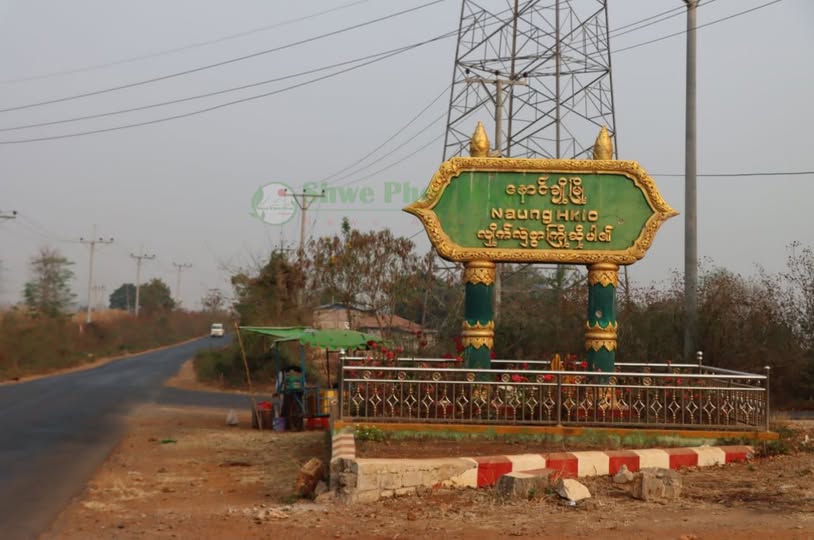
Nawnghkio Township, the first township seized by the Palaung State Liberation Front/Ta’ang National Liberation Army (PSLF/TNLA) during the second phase of Operation 1027, has fallen back into the hands of the junta’s military council after one year.
Nawnghkio, a strategic gateway to northern Shan State, was recaptured by the junta’s military on July 16. For months, the military employed all available means—ground offensives, airstrikes, artillery shelling, and drone bombings—in its efforts to retake the town.
Nawnghkio connects travelers from the upper regions to Pyin Oo Lwin and Mandalay, while those from the lower areas can access Lawksawk, Kyaukme, or Mogok through the township. Nawnghkio serves as a crucial transit point, both geographically and strategically.
How the Junta’s Military Retook Nawnghkio
According to the junta regime’s statement, the military launched an offensive targeting Tawnghkam Village and Banbwe Village (both on the Pyin Oo Lwin – Nawnghkio Road), and Ohmmati Village, where its former artillery battalion bases are located.
The junta stated that it launched counter-offensives starting in August 2024, employing coordinated efforts from its air force, artillery, and ground troops, in a bid to retake Nawnghkio.
Within an 11-month offensive period, the junta’s military engaged in nearly 600 clashes before finally being able to take Nawnghkio.
Frontline resistance sources defending the area reported that the junta’s military used hundreds of drone-dropped bombs and artillery shells on positions held by the TNLA and allied resistance forces before launching ground offensive attacks.
A resistance fighter who participated in the Nawnghkio conflict described the junta’s overwhelming tactics: “The junta’s military dropped bombs with drones like it was raining. And while we were lying down, they advanced on the ground.”
He also remarked that the unequal amount of arms and ammunition between the junta’s military and the TNLA and its allies was a significant factor in the resistance’s struggle to strongly defend against the offensive.
“If 10 were killed, another 10 advanced in; the junta’s military used troops like that,” he said.
BSO Chief on the Ground in Nawnghkio Battle
Military analysts note that in past battles, chiefs of the respective Bureau of Special Operations (BSO) typically remained in backlines to command operations.
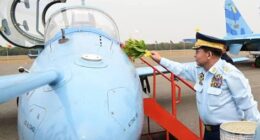
However, in the Nawnghkio Battle, Lieutenant General Naing Naing Oo, the chief of Bureau of Special Operations No. 2 (BSO-2), reportedly reached the ground to command his units directly at the frontlines. Photos of his presence in these frontline areas were also uploaded on pro-junta Telegram channels.
After junta military troops advanced to Kangyi Village, located just 16 km from Nawnghkio Town, the junta’s military itself began posting photos of Lieutenant General Naing Naing Oo on the frontlines.
“This is the very first time a BSO chief himself has reached the operation ground. From being a loser regional commander to becoming a Lieutenant General, that point could also motivate and encourage his troops,” said Captain Zin Yaw, a former junta military official who joined the Civil Disobedience Movement (CDM).
After junta troops successfully penetrated Nawnghkio Town on July 15, the junta released photos of Lieutenant General Naing Naing Oo, who had already arrived in the town.
Lieutenant General Naing Naing Oo previously served as the commander of the Northeastern Regional Command, based in Lashio, the capital of northern Shan State.
Despite Lashio falling to the Myanmar National Democratic Alliance Army (MNDAA) during the second phase of Operation 1027, Naing Naing Oo was not demoted. Instead, he was promoted from Major General to Lieutenant General.
TNLA and Allies’ comments on the Loss of Nawnghkio
According to a statement from the TNLA release on on July 16, at least 319 clashes broke out between the junta’s military and the ethnic armed group in Nawnghkio from May to July 15.
During the clashes, the junta’s military launched 106 airstrikes, conducted 162 drone attacks, fired artillery shells 4,692 times, and used poison bombs 186 times, according to the statement.
As clashes intensified in the town area from July 15, the TNLA relocated its civil departments from Nawnghkio to other areas. The group urged the populace to be aware of the dangers of the conflict as the clashes are expected to intensify further.
U Tun Tun Naing, chair of the Danu People’s Liberation Army (DPLA), which is fighting alongside the TNLA in Nawnghkio, has stated that their resistance group will continue fighting to retake the town.
“The clashes keep breaking out here. Our DPLA has no reason to stop working to get back Nawnghkio,” he told Shwe Phee Myay.
TNLA Alone Faces Intense Junta Offensive in northern Shan State
Following a ceasefire agreement brokered by China, clashes between the junta’s military and the Myanmar National Democratic Alliance Army (MNDAA) have ceased for several months.
Currently, the TNLA is solely facing the junta’s massive and intense offensive. Furthermore, it is enduring concentrated junta airstrikes that are exclusively targeting townships under TNLA control.
Conflict analysts anticipate that, having retaken Nawnghkio, the junta will continue its offensive to seize Kyaukme and Hsipaw Townships, which are located along the road connecting Nawnghkio and Lashio.
Furthermore, Capt. Zin Yaw, a former junta military official who joined the Civil Disobedience Movement after the coup, remarked that the junta could also continuously launch offensives on the towns it demanded during the negotiations in Kunming.
During China-brokered peace negotiations held in Kunming in late April, the junta demanded that the TNLA relinquish control of Nawnghkio, Kyaukme, Hsipaw, Mogok, and Momeik Townships. However, the TNLA rejected these demands.
Consequently, the junta is continuously launching airstrikes on towns controlled by the TNLA, alongside a massive offensive involving thousands of troops and an immense amount of shells and bombs.
“At this moment, the junta’s military is primarily attacking only the TNLA in northern Shan State and Karenni resistance forces on southern, targeting only these two as their key enemies. Therefore, now is truly the time for all revolutionary forces to launch offensive attacks in their respective territories,” said Capt. Zin Yaw.
Translated by #KLT
You can read and listen to our Shwe Phee Myay’s reports, not only on Facebook and our Website, but also on the following channels: