An Investigation by Mai A Naing
Panglong in southern Shan State—the historic town of the Panglong Conference and the signing of the landmark Panglong Agreement—has long stood as a symbol of national unity in Myanmar.
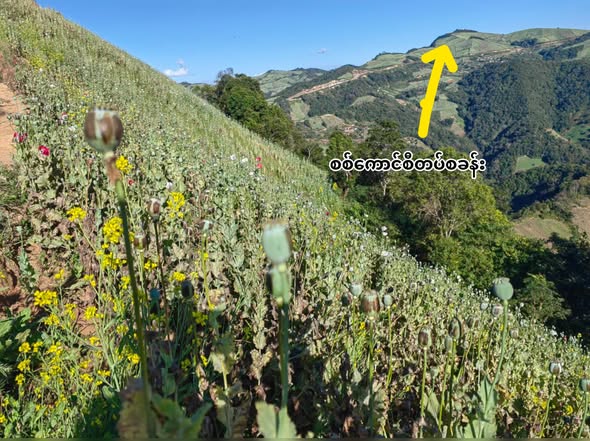
Today, however, just 4.8 km from this storied town, vast poppy fields spanning hundreds of thousands of acres are in full bloom.
These plantations lie along a shortcut linking Panglong to Hopong, a route commonly known as the “Kyauktan Road,” named after the large village of Kyauktan that travelers pass through.
Although the total distance between Kyauktan Village and Panglong is 70 km, roughly 32 km of the route are flanked by poppy fields stretching as far as the eye can see.
“I’ve seen poppy fields before, but never on this scale. No matter where you stop, they reach the horizon. I estimate there are at least 100,000 acres here,” said a driver who frequently travels the road.
These sprawling poppy fields lie just 64 km from Taunggyi, the capital of Shan State, and 11 km from Hopong, and only 4.8 km from the historic town of Panglong.
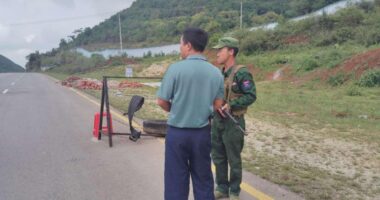
Along the road between the Kyauktan poppy growing area and Panglong, there are five checkpoints manned by various armed groups. These include two operated by the Pa O National Organization (PNO)—a militia allied with the junta’s military—one by the Shan State Progress Party (SSPP), one by the junta troops, and a final joint checkpoint run by the combined forces of junta military and PNO at the entrance to Panglong.
This entrance gate is reportedly the main location where authorities conduct drug inspections. A junta military’s outpost is also positioned roughly halfway between Kyauktan and Panglong. The outpost sits at a hilltop pagoda surrounded by poppy fields and the troops from a tactical unit of the junta are stationed.
The opium harvesting season is fast approaching, and travelers report a heavy military presence. Junta forces and various ethnic armed groups are arriving by vehicle to provide security for poppy farmers during the harvest.
The Panglong–Kyauktan road, once known for its peaceful and scenic atmosphere, has recently gone viral on social media. Travelers have been widely sharing TikTok videos of the vibrant, blooming poppy fields, sparking a surge of interest among people eager to visit the area.
Despite its newfound popularity, most travelers remain unfamiliar with this particular route. Those moving between Laihka and Taunggyi still rely on the main highway through Panglong, Loilem, and Hopong. Only a small number currently use the Kyauktan shortcut, which offers a direct link from Panglong to the outskirts of Hopong.
Some travelers avoid this road because of its steep and rugged terrain. Although it serves as a major thoroughfare, it is notably absent from Google Maps. The route was originally used mainly by locals, but it gained wider popularity as a shortcut in September 2024, when severe flooding in Loilem forced travelers to seek alternative paths.
According to a resident of Laihka, the poppy fields were first planted about two years ago. This timeline suggests the plantations emerged in the aftermath of the instability that followed the military coup.
Drivers who regularly travel this route expressed disbelief at how quickly hundreds of thousands of acres of poppy fields have appeared. They noted that because the plantations lie within territories controlled by the junta’s military, their existence would be impossible without the regime’s involvement.
According to the United Nations Office on Drugs and Crime (UNODC), Myanmar overtook Afghanistan in 2023 to become the world’s largest opium producer. In its latest report, released in this month, the UNODC confirms that Myanmar has maintained this position, with Shan State alone accounting for 88 percent of the country’s total poppy cultivation area.
Tragically, these vast, blooming poppy fields have become a form of dark tourism in Myanmar, even as the junta governing the country appears to be directly complicit in the trade.
~ ~ ~
Translated by #KLT
~ ~ ~
You can read and listen to our Shwe Phee Myay’s reports, not only on Facebook and our Website, but also on the following channels: