
By Mai Rupa, Shwe Phee Myay
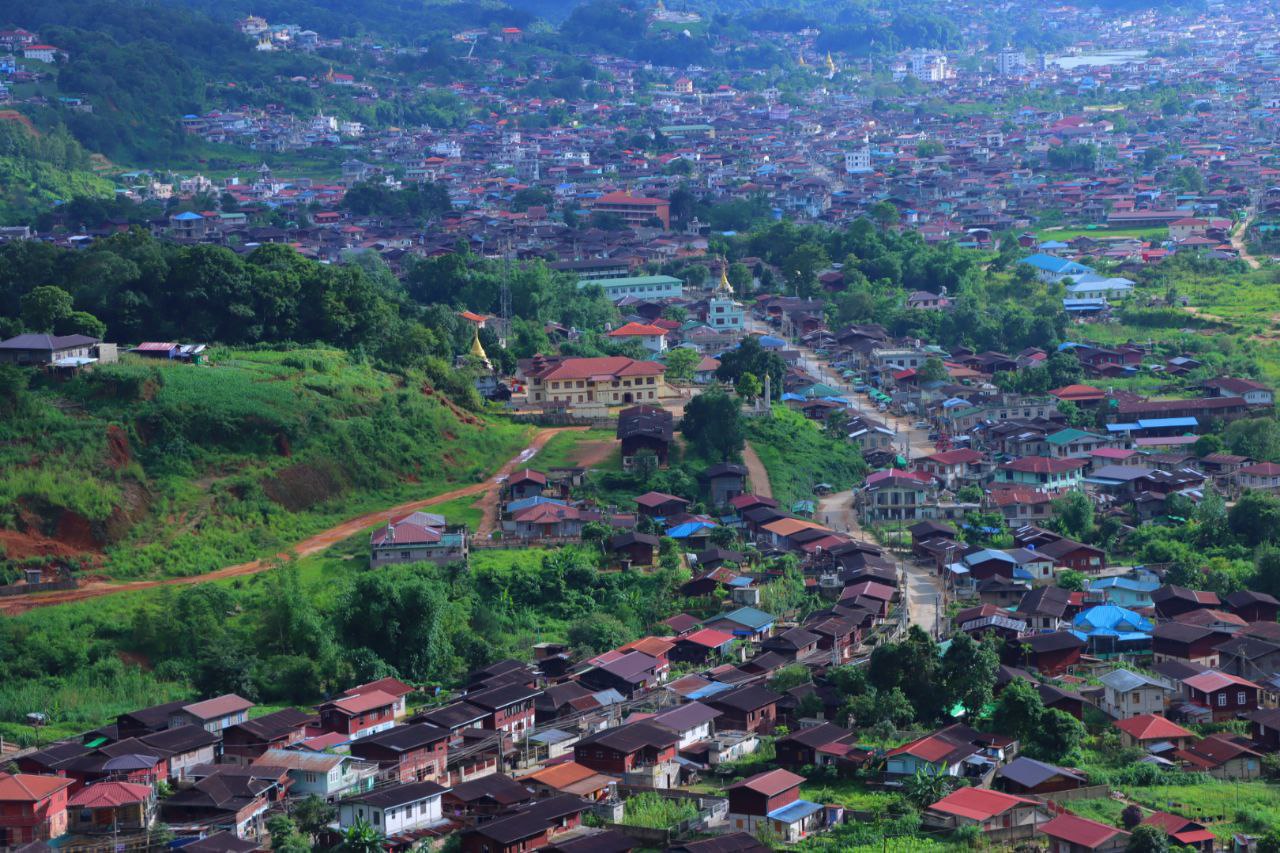
Following news of an imminent administrative shift in Mogok—a township regarded as a revolutionary stronghold—residents have been leaving almost daily.
Many say they are fleeing out of fear that the junta’s military will re-enter the town and that fighting may resume.
Those with the means are seeking refuge in major cities such as Yangon and Mandalay, while others are relocating to nearby townships considered relatively safe from the conflict.
“People are fleeing toward Yangon and Mandalay,” a Mogok resident told Shwe Phee Myay.
Many locals are closely monitoring the situation, questioning whether the Ta’ang National Liberation Army (TNLA) will assist the junta’s re-entry into Mogok, or whether the military will only move in after the ethnic armed group withdraws completely.
The uncertainty is heightened as the TNLA’s administrative mechanisms are currently still operating as usual in Mogok, and it remains unclear when their full withdrawal will occur.
Most residents of Mogok strongly oppose the return of the junta’s military, and on the night of November 6, nearly the entire town staged a protest by banging on pots and pans to express their rejection of military rule.
“The main reason is that people don’t want the junta to come back—due to the mediation China. So they protested by banging pots and pans,” said a male resident of Mogok.
Locals reported that residents from both eastern and western Mogok joined the anti-junta demonstration, which began at 8 p.m.
Mogok has long been regarded as a stronghold of the resistance, especially following the strong protests against the military coup in 2021. During Operation 1027, the town was seized by the TNLA and allied forces, and scenes of residents welcoming the resistance fighters further cemented this reputation.
Commenting on the pot-banging protest held on Thursday night, Dr. Soe Thura Zaw, a Mandalay PDF leader, stated on social media that while the junta’s military may gain territorial control, it will “never win the hearts of the people.”
“The people are what matter most,” he stressed.
The looming control shift stems from the China-mediated ceasefire between the TNLA and the junta’s military, under which the TNLA is expected to hand over control of Mogok and Momeik Townships to the junta.
The ceasefire, agreed upon by both sides starting October 29, prohibits the junta’s military from launching airstrikes or ground offensives against areas controlled by the TNLA, with both forces required to remain within their current positions.
Regarding the withdrawal, ground-level sources indicate the TNLA is expected to suspend its administrative operations in Mogok by November 20 and fully withdraw from both Mogok and Momeik Townships by November 25.
There are also unconfirmed reports that the TNLA may open a liaison office in Mogok, a detail Shwe Phee Myay has not yet been able to independently verify.
Revolutionary groups based in Mogok—including the Mandalay PDF and the Mogok Strategic Command—have declared their intention to defend the town and prevent it from falling back under the control of the junta’s military.
“We will resist and defend Mogok in coordination with our allied forces,” said a member of a Mogok-based resistance group.
Mogok was seized by the TNLA and allied resistance forces during the second phase of Operation 1027 on July 25, 2024.
However, the resistance’s ability to hold the town remains uncertain, as it hinges on the outcome of administrative transfer agreement between the TNLA and the junta’s military.
Should the TNLA forces withdraw from the town without assisting the junta’s entry, the remaining revolutionary groups believe they may be able to defend Mogok.
Lway Yay Oo, spokesperson for the TNLA, stated that the decision to agree to a ceasefire was “extremely difficult,” but was ultimately made to ensure the least harm to the public.
However, Lway Yay Oo has not disclosed the detailed terms of the agreement reached between the junta’s military and the TNLA during negotiations in Kunming, China.
Residents of Mogok—a town widely seen as a revolutionary stronghold—are increasingly concerned about the risk of arrest and torture should junta troops re-enter.
Much of the uncertainty hinges on whether the Kunming negotiations included provisions to protect those who were involved in or connected to the TNLA’s administrative apparatus.
“Crucially, the situation still depends on the outcome—the details of which remain unknown—of the agreement reached during the China-brokered talks,” said a male resident of Mogok.
Translated by #KLT
~ ~ ~
You can read and listen to our Shwe Phee Myay’s reports, not only on Facebook and our Website, but also on the following channels: