By Mai Rupa, Shwe Phee Myay
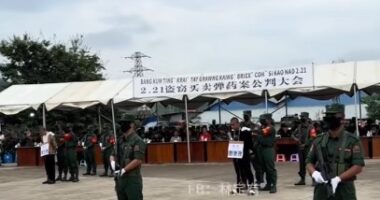
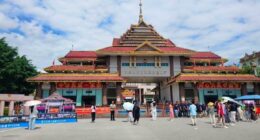
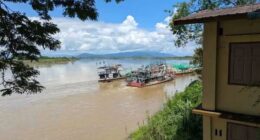
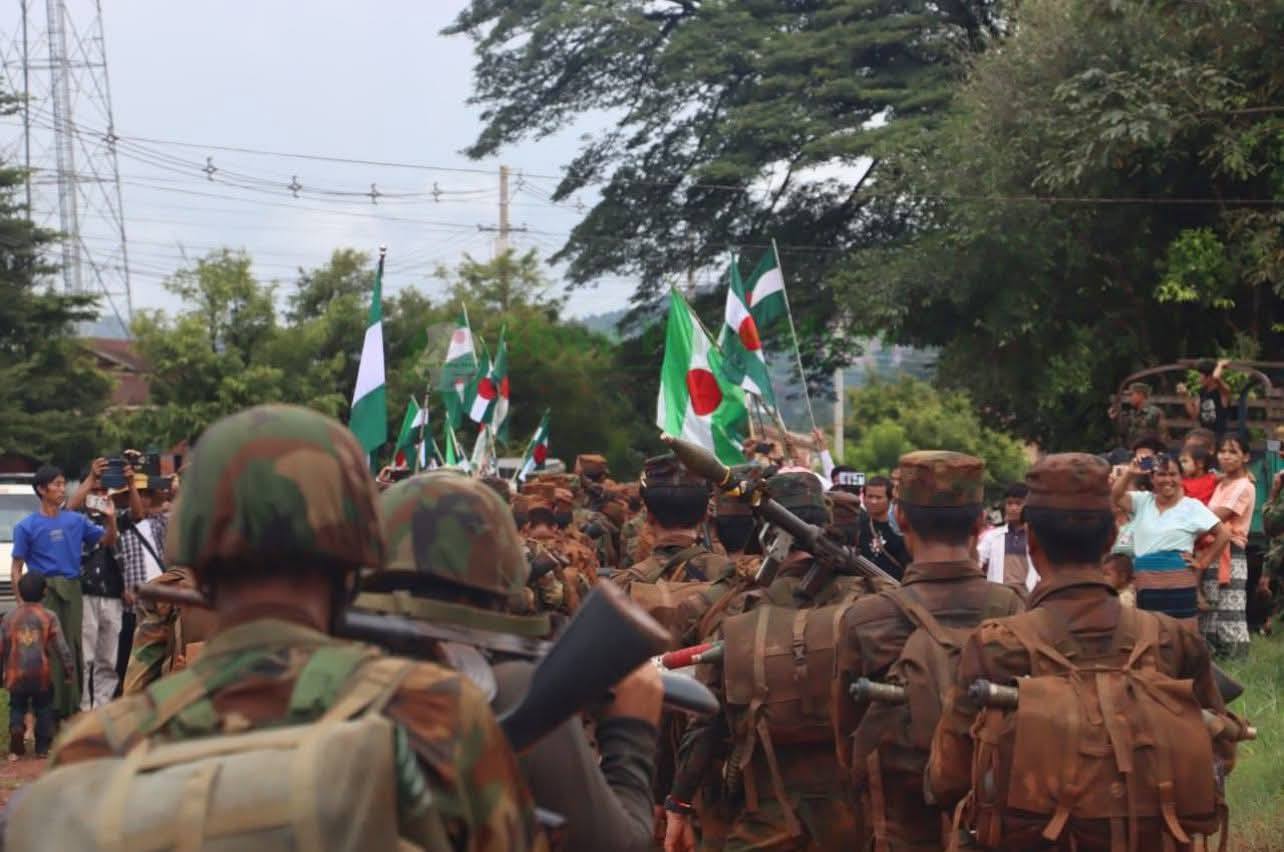
Following a China-mediated ceasefire agreement between the Ta’ang National Liberation Army (TNLA), the armed wing of Palaung State Liberation Front (PSLF), and the junta’s military, the armed group agreed to relinquish control of Mogok and Momeik Townships to junta forces.
The junta recently recaptured Nawnghkio, Kyaukme, and Hsipaw—towns previously seized by the TNLA during the second phase of Operation 1027—through military offensives. However, Mogok and Momeik were handed back following diplomatic intervention by China.
The ninth round of negotiations between the TNLA and the junta’s military, facilitated by China, took place on October 27 and 28 in Kunming.
The talks were attended by a delegation led by Lieutenant General Ko Ko Oo from the junta’s side and Deputy Commander-in-Chief Tar Jok Jar from the TNLA.
Although the TNLA had repeatedly rejected earlier demands to return the towns, mounting pressure ultimately led to their compliance.
Under the terms of the agreement, the junta’s military is required to refrain from conducting airstrikes or launching offensives into TNLA-controlled areas.
Both sides agreed to observe a ceasefire from their current positions, which became effective on October 29.
The duration of this ceasefire remains officially undefined.
Reverting to Phase One Status
During the second phase of Operation 1027, the Myanmar National Democratic Alliance Army (MNDAA), a member of Brotherhood Alliance along with the TNLA and Arakan Army, was compelled to hand over Lashio Town—previously under its control—to the junta in the last week of April, following Chinese intervention.
Consequently, all towns seized by the Brotherhood Alliance in northern Shan State and Mandalay Region during the second phase of the operation have now reverted to junta control.
This marks a return to the post–first phase status established under the Haigeng Agreement, which brokered a ceasefire between the junta’s military and the ethnic alliance.
Conflict analysts interpret the recent concessions as a sign that the Brotherhood Alliance is yielding to pressure from China.
At present, the TNLA continues to control the towns of Namkham, Kutkai, Namtu, Namhsan, Manton, Monglon, and Mongngawt.
Junta Cuts Off Lowland Rebels from northern Shan
As Operation 1027 gained momentum in northern Shan State, Spring Revolution forces—including the Mogok Strategic Command and Mandalay PDF (MDY PDF), both under the NUG—launched attacks on junta bases along the border of northern Shan State and Mandalay Region.
When launching as the Shan-Man Operation, the MDY PDF and allied forces captured towns like Singu and Thabeikkyin along the Mogok–Mandalay Road and successfully posed a military threat to the junta in Madaya and Patheingyi Townships near Mandalay city.
The TNLA and MNDAA jointly launched offensives against junta forces in northern Shan State, including the battle for Mogok. TNLA troops also advanced as far as the outskirts of Pyin Oo Lwin, threatening junta positions along the Lashio–Mandalay highway.
Despite this initial momentum, revolutionary forces came under pressure from China to halt hostilities. By late 2024, the northern Shan offensive began to lose ground and faced fierce counterattacks from junta troops.
Recently, junta forces have regained control of Nawnghkio, Kyaukme, and Hsipaw along the Mandalay–Lashio Union Highway. With the return of Mogok and Momeik, these actions have effectively severed the key routes and the link between revolutionary forces in northern Shan State and those in Mandalay Region.
Key Routes for Junta Entry into Mogok, Momeik
According to the TNLA statement, the group has agreed to withdraw from Mogok and Momeik Townships, though no specific territorial boundaries were outlined.
As the statement refers to the entire township areas, it is understood that TNLA forces are expected to withdraw from all parts of Mogok and Momeik.
The timeline for completing the withdrawal remains unspecified. However, information obtained by Shwe Phee Myay indicates that the TNLA is expected to pull out of both towns sometime in November.
Conflict analysts suggest that if the junta forces re-enter the Momeik and Mogok areas, they may utilize the Kyaukme–Monglon–Mogok route.
Shwe Phee Myay is currently attempting to contact Lway Yay Oo, the spokesperson for the PSLF/TNLA, to obtain further details on the withdrawal.
How Allies Respond to the TNLA’s Withdrawal?
The situation in Mogok and Momeik is more complex than the MNDAA’s handover of Lashio to the junta.
In Momeik, while the TNLA holds the urban center, the rural areas remain active zones for the Kachin Independence Army (KIA), the Shan State Progress Party/Shan State Army (SSPP), and other resistance forces born with Myanmar’s Spring Revolution.
Similarly, in Mogok, the TNLA controls the town center, but allied revolutionary forces continue to operate in the surrounding areas.
Critically, the Mogok Strategy Command and the Mandalay PDF, who fought alongside the TNLA for Mogok, have pledged to defend the territory they hold in Mandalay Region from falling back into junta hands.
“From my perspective, I don’t blame the TNLA. They must have their own challenges. Even if the military council moves in after their withdrawal, the TNLA isn’t the only force in Mogok—there are other groups operating there too,” said a revolutionary fighter who fought alongside the TNLA.
Revolutionary forces assess that after the junta regains control of Mogok and Momeik, they may launch offensives against the revolutionary forces in Mogok and within Mandalay Region.
Revolutionary Stronghold of Mogok
The sight of the public welcoming the TNLA and allied forces when they attacked and captured Mogok town was a significant psychological threat to the junta troops and their supporters.
Therefore, pro-junta Telegram channels frequently called for continuous bombing of Mogok, and the strictly tightened inspections of Mogok residents traveling through junta-controlled areas.
Currently, some Mogok residents are criticizing the TNLA for handing the town back to junta without even needed to fire a single shot.
“Everyone is sad. They are worried about what they will do if the junta forces come in,” said a Mogok resident.”
Translated by #KLT
~ ~ ~
You can read and listen to our Shwe Phee Myay’s reports, not only on Facebook and our Website, but also on the following channels: