By Hlar Nyiem | Shwe Phee Myay
For the election, which is only about half a month away, the junta’s military is going door-to-door collecting household registration lists to garner votes.
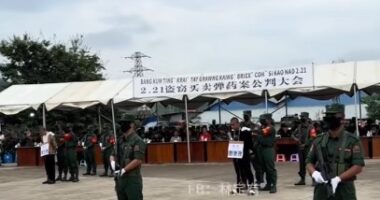
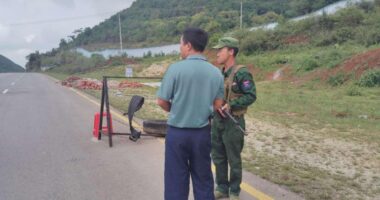
These kinds of scenes have been frequently observed in recent days in Muse, a trading town located on the China-Myanmar border. Muse is a place under the control of the junta’s regime and is scheduled to hold the election.
The teams going door-to-door to collect voter lists, household registration lists, and ID card lists include not only the Department of Immigration and Population (IPRD) but also the police forces and local administrators.
There is little public interest, and since the last week of November the junta has been desperately attempting to secure votes for an election that lacks genuine support.
A woman living in Muse town, who requested anonymity for security reasons, told Shwe Phee Myay that residents are facing both pressure and threats to cast ballots for the military-backed party.
“If we don’t vote for their party, they won’t issue the Red Books (border pass) anymore. They spoke in a way that made it clear we absolutely have to vote for them,” she said.
The “Red Book” she referred to is the border crossing permit required for travel into China. Valid for one year, it is indispensable for Muse locals who rely on cross-border work and trade.
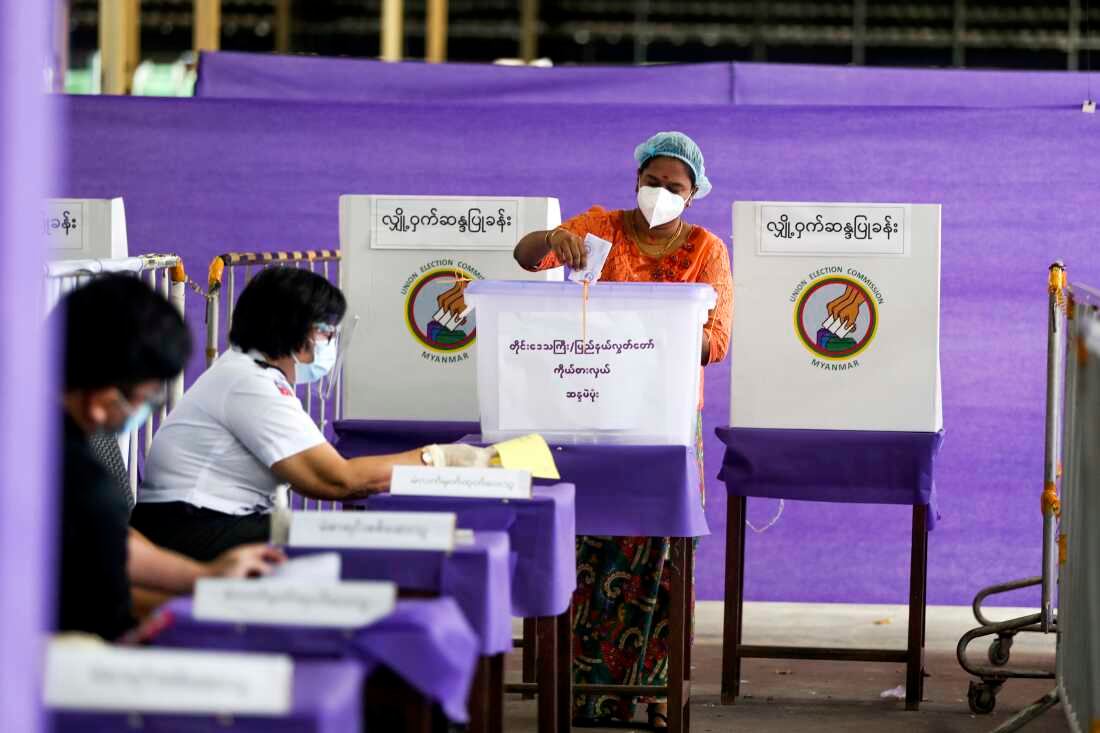
Before the coup, the atmosphere in Muse during election season was markedly different. Sixty days ahead of the vote, various parties would campaign openly, and the streets would be alive with music and parties’ rally activities.
In contrast, the upcoming 2025 election organized by the military regime is unfolding in silence—quiet, subdued, and desolate.
That is why the international community has concluded that this election cannot be fair, as it lacks genuine support beyond a small group aligned with the military. Revolutionary forces have urged the public to boycott the vote organized by the junta regime, issuing repeated statements of objection.
A resident in a military-controlled area of northern Shan State explained the dilemma: “We don’t like them. But since we are in their territory, for some matters, we have to nod our heads to whatever they say. When it actually comes to the election, I may or may not cast my vote. That’s my own choice, right?”
In the first phase of the election, scheduled for December 28, constituencies include Lashio town. The military regime regained control of Lashio from the Myanmar National Democratic Alliance Army (MNDAA) with China’s assistance, without direct fighting.
Yet even there, the atmosphere is marked by indifference. The majority of residents show little interest in the junta’s election, apart from a small circle of military supporters.
During the voter list announcement period, issued by the junta’s election commission from November 21 to December 4, there was so little public interest that authorities resorted to house-to-house verification.
Teams composed of police officers, officials from the Ministry of Immigration and Population (MIP), and the General Administration Department (GAD) went into the wards, showing and cross-checking the voter lists directly with residents.
“They took a copy of our household registration and checked it against the voter list,” said a male resident of Lashio town.
For the first phase of the election in northern Shan State, polling will be held in three townships: Lashio, Muse, and Nawnghkio. Nawnghkio was recently retaken by the junta’s military from the Ta’ang National Liberation Army (TNLA).
The second phase of voting will expand to 17 townships across Shan State, including Tangyan and Mongyai in the north.
During the junta’s election in northern Shan State, three parties are set to compete: the military-backed Union Solidarity and Development Party (USDP), the People’s Pioneer Party (PPP), and the Shan Nationalities Democratic Party (SNDP), commonly known as the White Tiger Party. However, residents report that visible campaigning is only being carried out by the USDP.
Locals say they are aware that three parties will contest, but most remain uncertain about who the actual candidates are. Despite widespread distrust and rejection of the election organized by the junta, China, Myanmar’s neighboring country, has publicly expressed support for the process.
Regardless of objections from revolutionary forces and local communities, the junta’s regime has confirmed the dates for Phase 1 and Phase 2 of the election and insists it will proceed by any means necessary.
Translated by #KLT
~ ~ ~
You can read and listen to our Shwe Phee Myay’s reports, not only on Facebook and our Website, but also on the following channels: